OUTREACH

Little Steps Big Dreams

78 children reached with hands-on literacy and numeracy sessions, supported by home-learning kits, while 14 caregivers gained practical health and nutrition guidance. Early learning gaps were identified and addressed, with measurable gains in letter recognition, counting, and confidence. Integrated, low-cost interventions demonstrated clear impact and highlighted the urgent need for follow-up and continued support in Koiwo.
Executive Summary
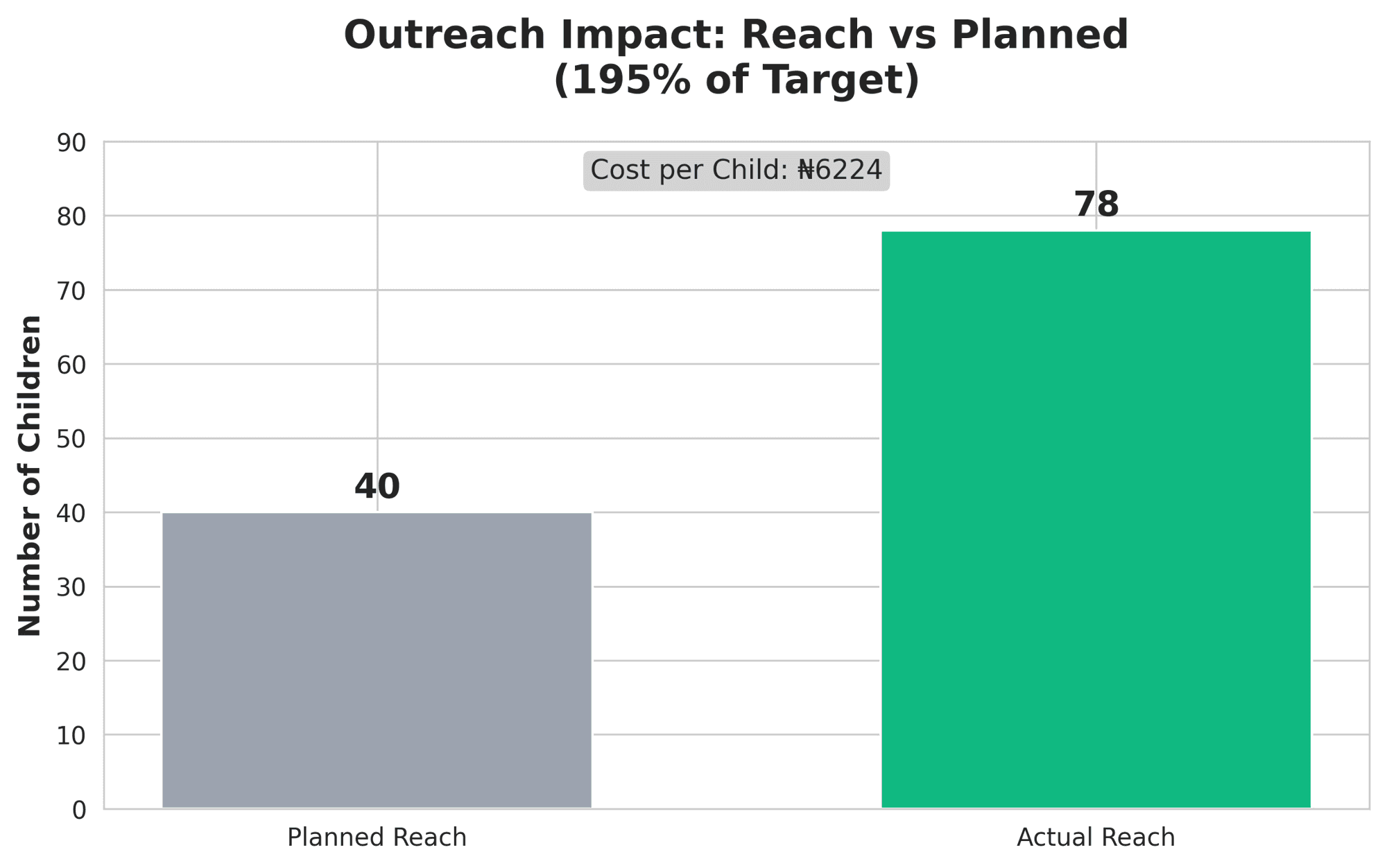
In one targeted 4-hour intervention, LSBD reached 78 children (195% of the planned 40), delivering integrated foundational literacy, numeracy, academic reinforcement, and caregiver health & nutrition education.
Key Results:
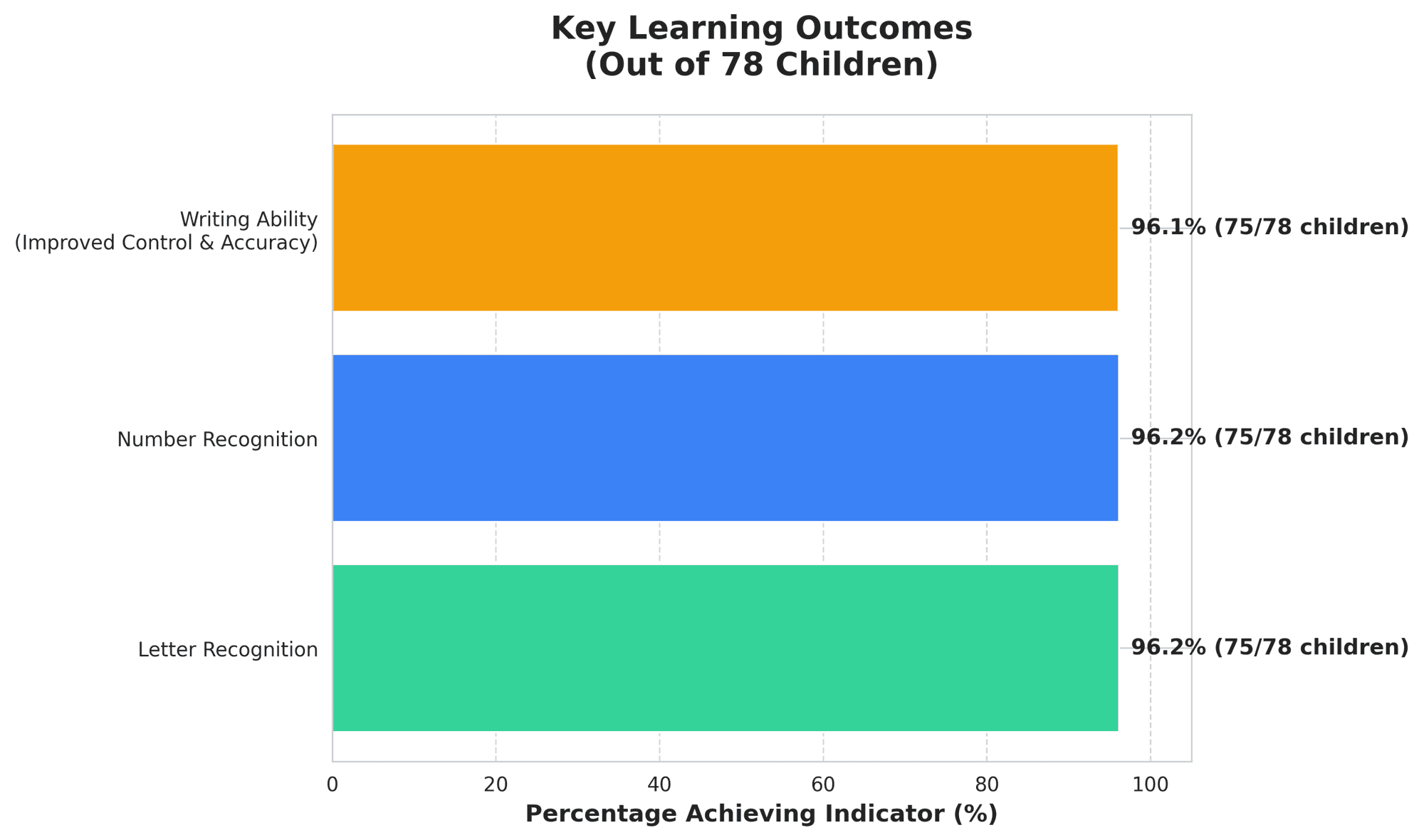
96.15% of children (75/78) achieved letter and number recognition.
96.1% showed measurable improvement in writing control and accuracy.
Home learning kits distributed to all 78 children for daily practice.
14 caregivers engaged in practical hygiene, illness prevention, and nutrition sessions linked directly to cognitive development.
Cost Efficiency: ₦485,500 total | ₦6,224 per child (significantly below planned due to higher turnout). Model: Evidence-based, low-resource, scalable – proven to close early learning gaps in rural Nigerian communities.
This intervention directly supports SDG 4 (Quality Education), SDG 2 (Zero Hunger), and SDG 3 (Good Health and Well-being) through integrated, measurable outcomes.
At a Glance
78 children reached 2 age-specific learning bands 100% received home-practice kits 14 caregivers equipped with nutrition & health tools 195% of planned reach achieved
1. Background & Rationale
Koiwo Community, like many rural areas in Osun State, faces persistent challenges in early learning: limited access to quality pre-primary education, weak foundational literacy/numeracy, and household-level gaps in nutrition and hygiene that directly affect cognitive development.
The outreach was designed to:
Address immediate learning gaps through practical, low-resource methods.
Build caregiver capacity to support learning at home.
Demonstrate a scalable, integrated model (Education + Health + Nutrition) that prevents the compounding of foundational deficits.
The Belief we have is: If children receive hands-on, age-appropriate literacy/numeracy practice + caregivers gain practical health/nutrition knowledge → then immediate skill gains occur, home practice routines begin, and long-term learning outcomes improve while reducing health-related absenteeism.
1.1. Programme Objectives
Primary Objective: Close early learning gaps in literacy and numeracy for 40–60 children while equipping caregivers with actionable health and nutrition strategies.
Specific Objectives:
Achieve at least 80% mastery in letter and number recognition among ages 3–8.
Improve writing control and basic comprehension/arithmetic for ages 9–16.
Engage at least 10 caregivers in sessions linking nutrition to learning ability.
Distribute home learning kits to enable 30+ days of independent practice
1.2. Programme Overview
Programme Components (Delivered Simultaneously):
Foundational literacy & numeracy (ages 3–8)
Academic reinforcement in English & Mathematics (ages 9–16)
Health & nutrition awareness for caregivers + older children
Direct material support (home learning kits for every child)
Delivery Approach: Small-group facilitation (max 10–12 children per volunteer), repetition-based practice, hands-on activities using physical objects, and real-time volunteer guidance. All sessions were designed for low-resource environments with no electricity or digital tools required.
2. Participation & Demographics
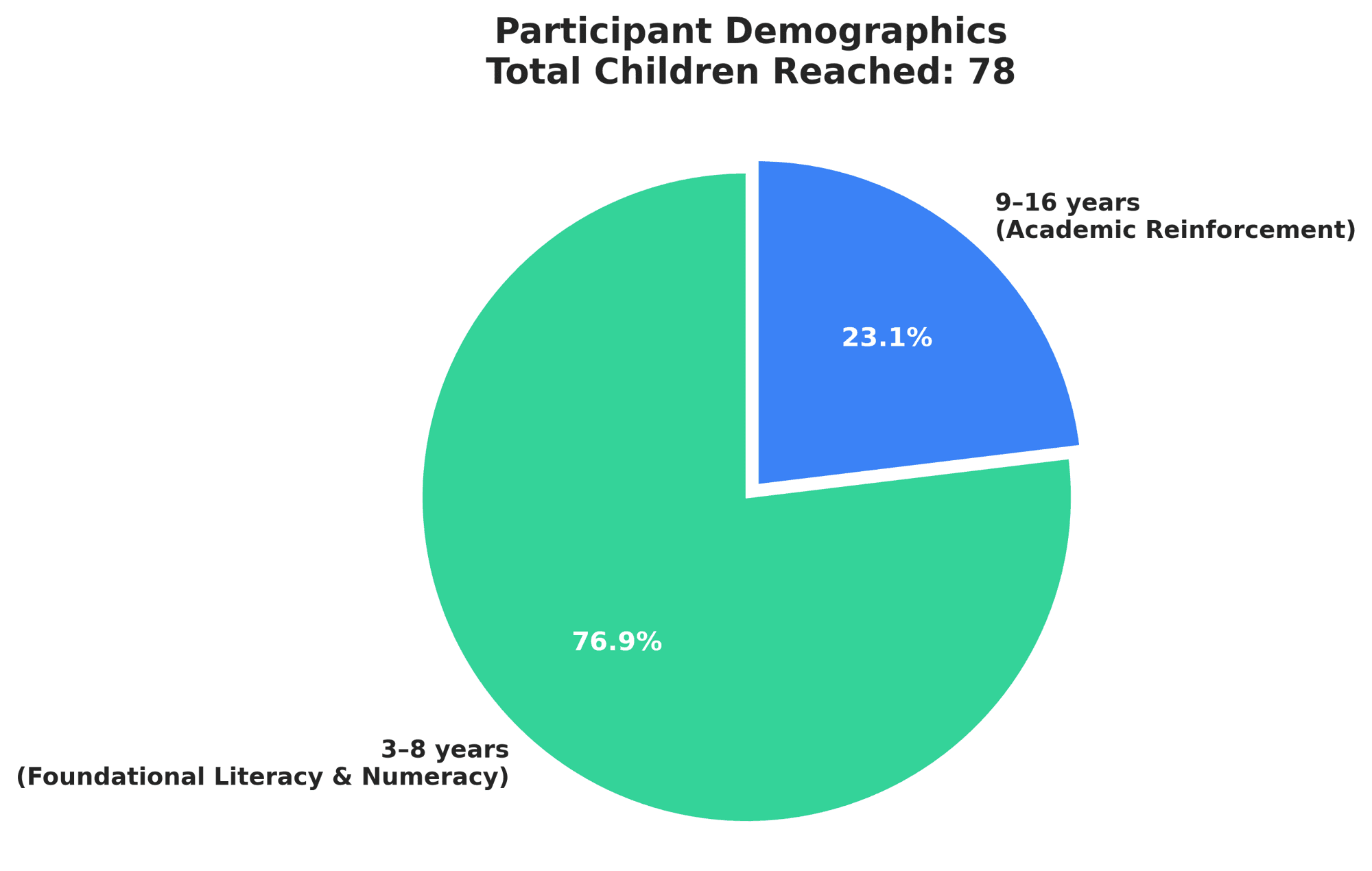
Total Children Reached: 78 Session Duration: 4 hours Age Bands: 2 parallel streams (no child left disengaged)
Age Group | Children | % of Total | Focus Area |
|---|---|---|---|
3–8 years | 60 | 76.9% | Foundational literacy & numeracy |
9–16 years | 18 | 23.1% | English & Mathematics reinforcement |
Critical Insight: One 16-year-old participant (currently in JSS1) was assessed as 4–5 years behind expected academic level. This single case illustrates the compounding effect of unaddressed foundational gaps and underscores the urgency of early intervention plus sustained follow-up for older learners.
3. Programme Structure
Three coordinated streams ensured 100% active engagement while caregivers received parallel training.
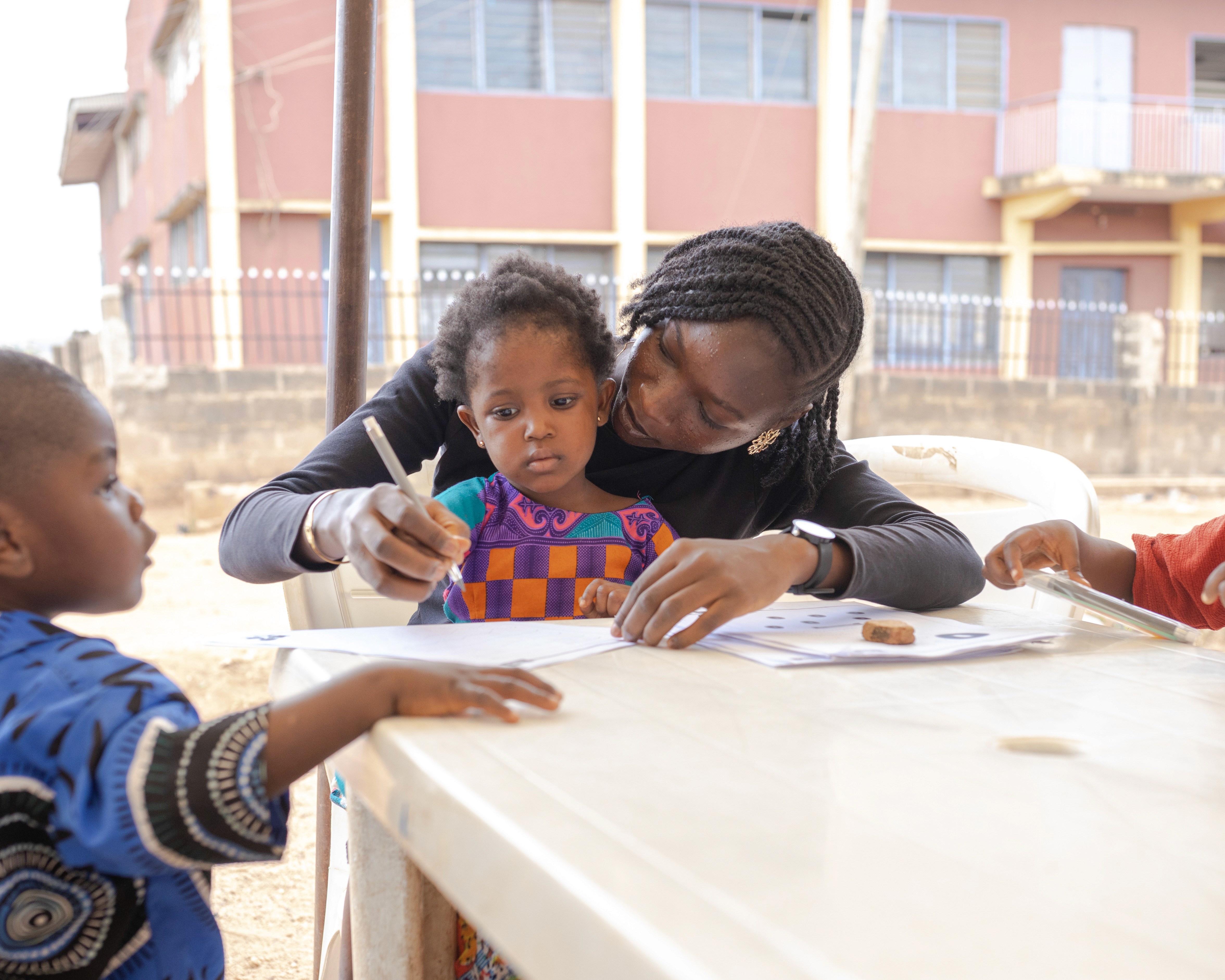
Stream A: Early Learning (Ages 3–8, 60 children)
Literacy: A–Z alphabet recognition, guided tracing, letter-sound association
Numeracy: Number recognition 1–20, counting with physical objects, number tracing
Delivery: Small groups, repetition drills, hands-on objects, volunteer 1:8 ratio
Targeted Outcomes: Confidence building, pencil control, daily practice routines
Stream B: Academic Support (Ages 9–16, 18 children)
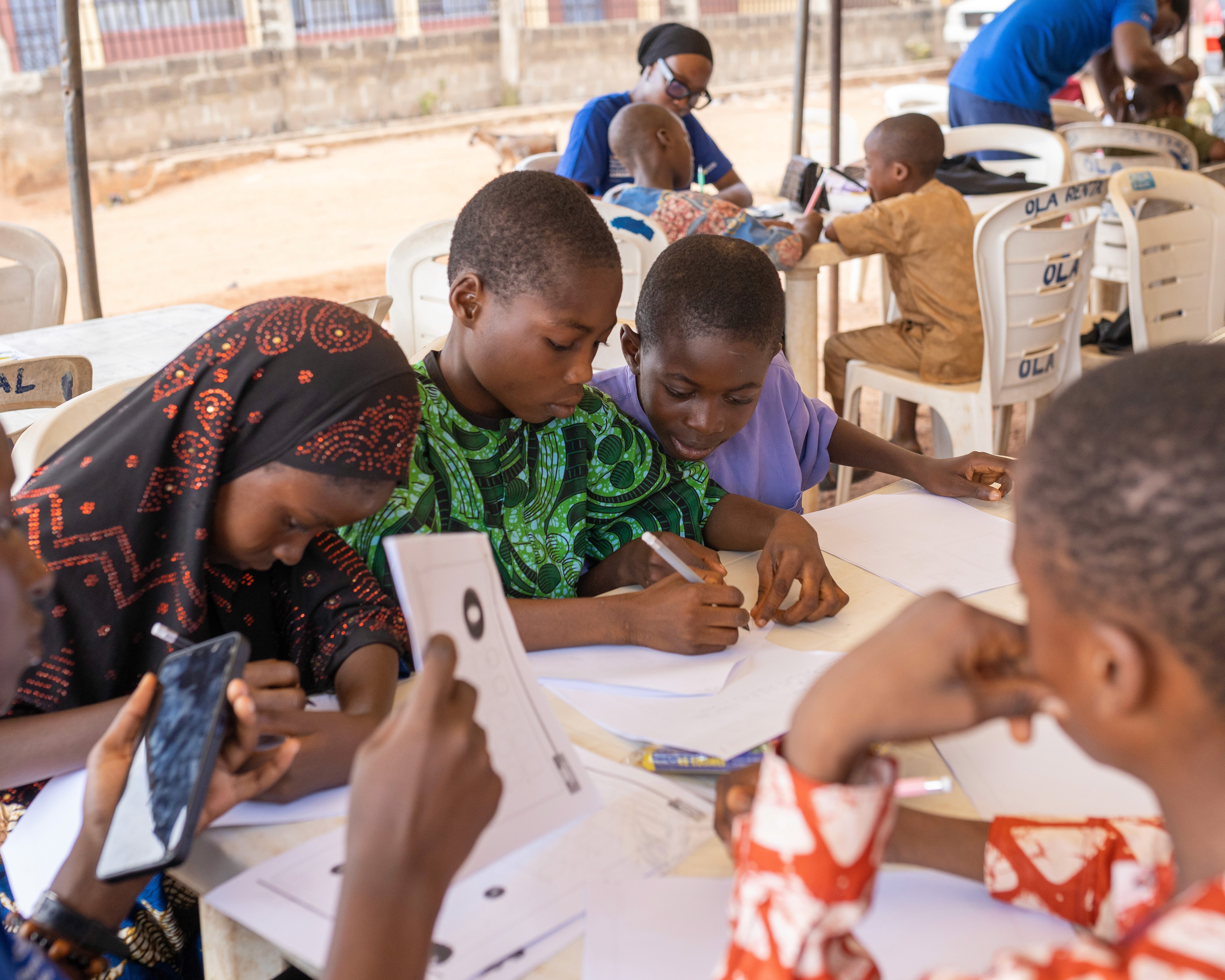
English: Reading fluency, basic comprehension, sentence construction
Mathematics: Arithmetic operations, number sense reinforcement
Delivery: Level-adapted, interactive, one-on-one volunteer support where needed
Safeguard: Every child remained actively engaged with content matched to their assessed level
Stream C: Health & Nutrition (Caregivers + Older Children, 14 caregivers)
Led by: Health professionals and a certified nutritionist Topics Delivered:
Basic hygiene practices (handwashing, sanitation)
Prevention of common childhood illnesses
Early health intervention protocols
Affordable, locally available nutrition for brain development
Direct link between nutrition and learning ability
Method: Conversational, real-life examples, open Q&A – designed for immediate household adoption.
4. Materials Distributed (Home Learning Kits)
Every child (78) received a complete kit to enable 30+ days of continued practice at home:
1 Literacy Book (Alphabet-based with tracing exercises)
1 Numeracy Book (Counting & number activities)
1 set Writing pencils
1 set Coloring pencils
1 branded tote bag for storage
Purpose: Reinforce session concepts, build independent daily practice routines, and extend impact beyond the single-day event.

5. Programme Outcomes & Impact Measurement
A. Learning Metrics (Observed & Measured On-Site)
Metric | Method | Indicator | Result |
|---|---|---|---|
Letter Recognition | Observation | Correct identification of A–Z | 75/78 children (96.15%) |
Number Recognition | Activity-based | Correct counting & recognition | 75/78 children (96.15%) |
Writing Ability | Tracing exercises | Improved control & accuracy | 75/78 children (96.1%) |
B. Engagement & Retention Metrics
Metric | Indicator | Result |
|---|---|---|
Participation Rate | Actively involved throughout | 78/78 (100%) |
Session Completion | Completed all tracing + counting tasks | 71/78 children (91%) |
Caregiver Attendance | Attended at least one health session | 14 caregivers |
Confidence | Independent task attempts post-guidance | 75/78 (96.15%) |
Retention | Correct repetition on second attempt | 72/78 (92.3%) |
Parent Follow-Through: TBD – to be measured via 30-day follow-up calls/visits.
6. Financial Summary & Cost Efficiency
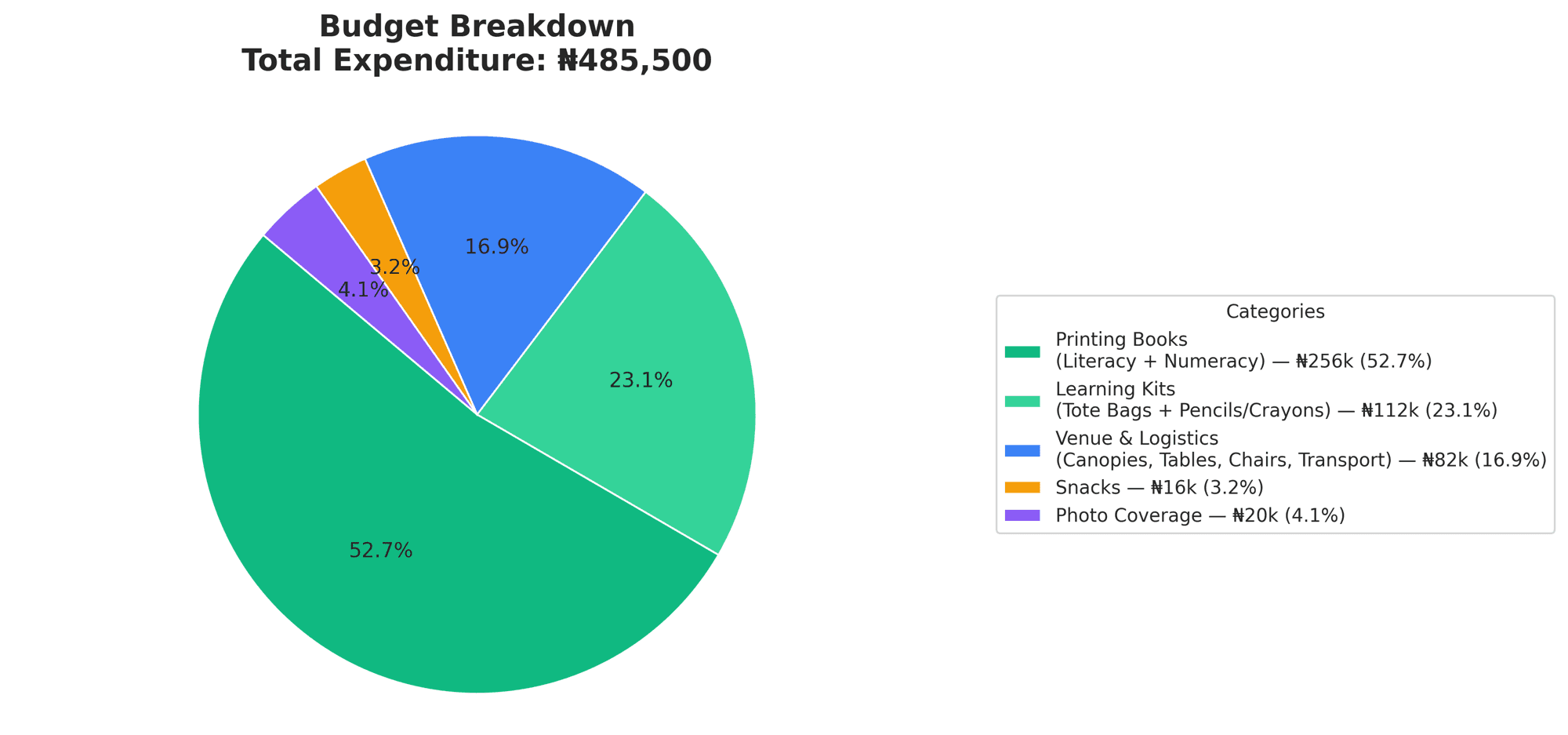
Total Expenditure: ₦485,500 (prepared for 40 children; served 78) Cost per Child: ₦6,224 (highly efficient due to higher turnout) To fund the outreach, we had called for donations, which came in to an amount of ₦130,000 and the rest of the money was pooled in by the members of the Core Team.
Detailed Breakdown:
Category | Amount (₦) | % of Total |
|---|---|---|
Printing (Literacy + Numeracy Books) | 256,000 | 52.7% |
Learning Kits (Tote Bags + Pencils/Crayons) | 112,000 | 23.1% |
Venue & Logistics (Canopies, Tables, Chairs, Transport) | 82,000 | 16.9% |
Snacks | 15,500 | 3.2% |
Photo Coverage | 20,000 | 4.1% |
Total | 485,500 | 100% |
7. Team & Volunteers
Core LSBD Team:
Dorcas Ezekiel – Founder, Designer & Programme Lead
Anjolajesu Emmanuel – Media & Content Manager
Emmanuella Oni – Outreach & Sponsorship Lead
Ademola Adewale – Logistics Coordinator
Volunteers (7): ADENIRAN TESTIMONY AYOBAMI, Mojolaoluwa Nihinlola Idowu, Peace Temidayo Osin, Ikeoluwa Deborah Awominure, Olagunju Faith Jesupelumi, Olowogunle Roseline, Odiamehi Deborah Toluwanimi, Ezekiel Ifeoluwa, Ezekiel Dvid, Oladimeji Boluwatife
Health & Nutrition Experts (2): Obe Victoria, Ajayi Tolulope
8. Challenges (Observed & Documented)
Funding shortfall: Prepared materials/logistics for only 40 children
Lack of enclosed venue → environmental distractions
Wide variation in learning levels within bands
Single-session format limited depth and retention measurement
9. Recommendations for Scale & Sustainability
Budget for 150% turnout in future planning (proven pattern).
Secure enclosed venues (e.g., community halls) to increase focus and assessment accuracy.
Implement level-based materials + pre-assessments for older learners.
Commit to 3–4 follow-up sessions per cohort to drive measurable long-term gains.
Expand caregiver track with take-home nutrition action plans and WhatsApp support groups.
Conclusion & Call to Action
The Koiwo Outreach proves that a single, well-designed, integrated intervention can deliver 96%+ learning outcomes and reach nearly double the planned number of children in a low-resource setting.
By combining hands-on education, targeted academic support, and caregiver health/nutrition training, LSBD created immediate impact and laid the foundation for sustained household-level change.
All photographs remain the property of LSBD. Full photo folder: Google Drive
Thank you for supporting foundational learning in Nigeria.
Make a donation and create impact in this world
Operating in more than Osun State, Nigeria to support underserved communities

